


SMD Resistor Code: A Complete Guide to Understanding Surface Mount Resistor Markings
Introduction
Modern digital gadgets are turning into smaller, faster, and extra effective each day. From smartphones and laptops to industrial manage structures and automobile electronics, nearly each cutting-edge circuit board incorporates heaps of tiny digital components. Among these components, the resistor is one of the most many times used passive components.
Traditional through-hole resistors normally have colored bands to point out their resistance value. However, Surface Mount Device (SMD) resistors use a distinct identification approach due to the fact of their extraordinarily small size. Instead of shade bands, producers print numerical codes at once on the floor of the resistor.
Understanding SMD resistor codes is an quintessential ability for electronics engineers, technicians, PCB restore specialists, and anybody worried in motherboard repair. Correctly figuring out an SMD resistor cost helps stop circuit injury and approves technicians to change broken factors accurately.
This article explains what SMD resistors are, how their coding device works, specific sorts of resistor markings, calculation methods, and sensible examples.
What is an SMD Resistor?
An SMD Resistor (Surface Mount Device Resistor) is a variety of digital resistor that is designed to be set up onto the floor of a Printed Circuit Board (PCB) without the use of regular wire leads. Unlike standard through-hole resistors, SMD resistors are very small in dimension and are located on the PCB ground the use of computerized assembly machines.
SMD resistors are one of the most often used passive digital aspects in cutting-edge digital units such as smartphones, laptops, televisions, laptop motherboards, electrical energy supplies, auto electronics, and industrial control systems.
The principal cause of an SMD resistor is the equal as a day-to-day resistor: to manipulate the flow of electric powered powered present day and create a special voltage drop in an digital circuit.
Construction of an SMD Resistor
An SMD resistor has a very compact structure consisting of numerous layers:
1. Ceramic Substrate
The base fabric of an SMD resistor is commonly made from notable ceramic material. This ceramic layer offers mechanical power and electrical insulation.
2. Resistive Layer
A skinny resistive film is located on the ceramic substrate. This layer creates the required resistance value. The fabric used for this layer is usually:
- Metal oxide
- Thick film resistive material
- Thin film metal material
The resistance price depends upon on the material composition, thickness, and dimension of this resistive layer.
3. Protective Coating
The resistive aspect is blanketed with a shielding coating. This layer protects the resistor from:
- Moisture
- Dust
- Mechanical damage
- Temperature changes
4. Metal Terminations
Both ends of an SMD resistor contain metal terminals. These terminals allow the resistor to be soldered without delay onto PCB copper pads.
The terminals normally contain:
- Nickel barrier layer
- Tin coating for soldering
Working Principle of an SMD Resistor
An SMD resistor works in accordance to the equal precept as any unique resistor. When electrical state-of-the-art passes via the resistor, the resistive fabric opposes the action of electrons. This opposition is recognized as resistance.
The relationship between voltage, current, and resistance is described through Ohm’s Law:
V = I × R
Where:
- V = Voltage
- I = Current
- R = Resistance
A higher resistance value allows less current to flow, while a lower resistance value allows more current to flow.
SMD Resistor Appearance
SMD resistors are very small rectangular components. They usually have:
- A black, dark gray, or green body
- Metal contacts on both sides
- Printed numbers or codes on the top surface
Example:
┌───────────┐
│    103    │
└───────────┘
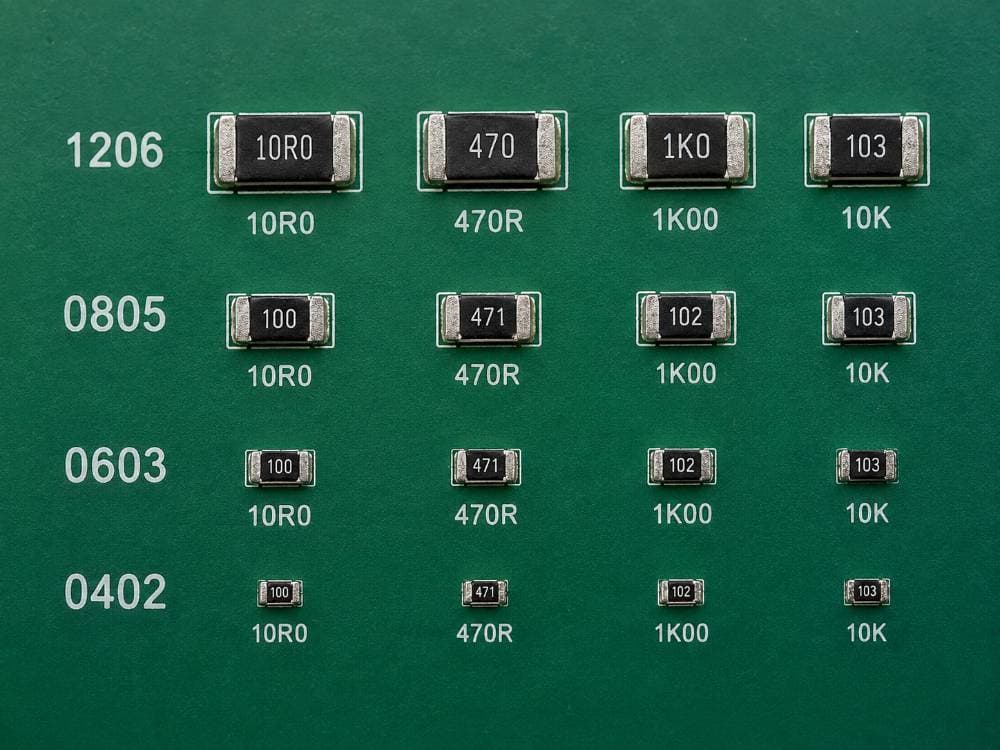
This means that the resistance value is represented as 103.
The first two values are significant digits: 10
The third number is the multiplier: 10 × 10³
Therefore:
103 = 10,000Ω = 10kΩ
Common SMD Resistor Sizes
SMD resistors are classified based on their physical dimensions. Common sizes include:
| SMD Size | Dimensions |
|---|---|
| 0201 | 0.6mm × 0.3mm |
| 0402 | 1.0mm × 0.5mm |
| 0603 | 1.6mm × 0.8mm |
| 0805 | 2.0mm × 1.25mm |
| 1206 | 3.2mm × 1.6mm |
| 2512 | 6.3mm × 3.2mm |
Smaller packages are found in small devices, such as mobile phones and wearable electronics; whereas larger packages will manage higher-powered applications.
Types of SMD Resistors
Thick Film SMD Resistor
Thick film resistors are the most widely used types of SMD resistor.
Features:
- Low cost
- Good reliability
- Used in customary digital circuits
- Available in many resistance values
Applications:
- Motherboards
- Consumer electronics
- Power circuits
Thin Film SMD Resistor
Compared to thick film types, thin film resistors offer much better accuracy.
Features:
- Low temperature coefficient
- High precision
- Better stability
Applications:
- Medical equipment
- Measurement devices
- Precision circuits
Metal Film SMD Resistor
Metal movie resistors provide:
- Excellent stability
- Low noise performance
- High accuracy
Power SMD Resistor
Power SMD resistors are constructed to handle increased heat and power.
Applications:
- Power supplies
- Motor controllers
- Battery management systems
SMD Resistor Marking Codes
SMD resistors being minuscule, printers do not recommend writing out the complete value of resistance and thus they use printed codes instead.
Common marking systems include:
Three-Digit Code
Example: 472
Calculation:
47 × 10² = 4700Ω = 4.7kΩ
Four-Digit Code
Used for higher precision resistors.
Example: 1002
Calculation:
100 × 10² = 10,000Ω = 10kΩ
EIA-96 Code
Used for precision SMD resistors.
Example: 01A
This code represents a specific resistance price according to the EIA-96 standard.
Advantages of SMD Resistors
SMD resistors offer several benefits compared to traditional resistors.
- Small Size: The modular design allows several devices to be integrated onto each other, which due to their small form factor increases factors can be hooked up on a smaller PCB.
- High-Speed Manufacturing: SMD elements are mounted robotically, the usage of pick-and-place machines that take account of handling.
- Better High-Frequency Performance: This smaller body size decreases unwanted electrical effects such as parasitic capacitance and inductance, making them great for high-frequency circuits.
- Lower Weight: SMD factors reduce the regular weight of electronic instruments.
- Better PCB Design: It allows manufacturers to produce smaller difficult circuit boards.
Applications of SMD Resistors
We can locate SMD resistors in nearly each and every cutting-edge digital device.
Common functions include:
- Computer motherboards & Laptop circuits
- Mobile phones
- LED lights fixtures systems
- Television circuits & Audio equipment
- Network devices
- Automotive manipulate units
- Industrial machines
- Power furnish boards
Testing an SMD Resistor
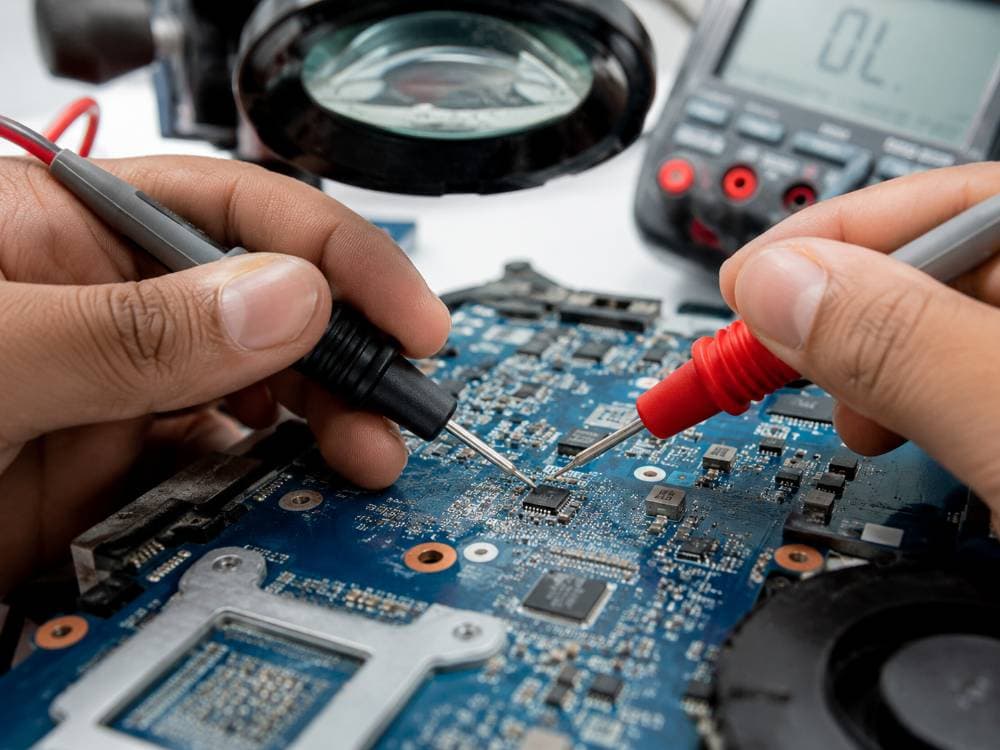
In the case of SMD resistors we can check with digital multimeter.
Testing method:
- Set the multimeter to resistance (Ω) function.
- Connect the probes to each sides of it.
- Read the displayed resistance value.
- Compare the measured value with expected one.
A mega resistor needs to show a charge close to its rated resistance.
In addition, a malfunctioning resistor may also exhibit:
- 0Ω (short circuit)
- Infinite resistance (open circuit)
- Incorrect resistance value
Why SMD Resistors are Essential in Modern Electronics
Digital gadgets now require factors that are:
- Smaller
- Faster
- More reliable
- Energy efficient
No doubt, SMD resistors enables engineers to design compact and wonderful electronic systems. Without SMD technology, gadgets like smartphones, laptops and perfect laptop hardware could be plenty large and better luxurious to manufacture.
As a result of this, SMD resistors are an necessary factor in right now's PCB design and digital repair.
SMD Resistor Sizes Detailed
SMD resistors come in various package sizes depending on the available physical space, collector efficiency capacity, and application. A four-digit code based on the dimensions defines the size for an SMD resistor.
The first two digits denote the length, with the last two digits representing the width. The unit of measure is typically hundredths of an inch (imperial code).
Example: 0805
- 08 = Length = 0.08 inch
- 05 = Width = 0.05 inch
There are also metric sizes which are measured in millimeters.
Common SMD Resistor Sizes Table
| SMD Code Imperial | Size Imperial (mil) | Dimensions (mm) | Notes / Application |
|---|---|---|---|
| 01005 | 01005 | 0.4 × 0.2 mm | Extremely small |
| 0201 | 0201 | 0.6 × 0.3 mm | Ultra compact |
| 0402 | 0402 | 1.0 × 0.5 mm | Small electronics |
| 0603 (or 603) | 0603 | 1.6 × 0.8 mm | Most widely used small footprint |
| 0805 | 0805 | 2.0 × 1.25 mm | General purpose |
| 1206 | 1206 | 3.2 × 1.6 mm | Higher power applications |
| 1210 | 1210 | 3.2 × 2.5 mm | Medium power |
| 2010 | 2010 | 5.0 × 2.5 mm | High power |
| 2512 | 2512 | 6.3 × 3.2 mm | Very High Power |
01005 SMD Resistor
Size: 0.4mm × 0.2mm
Features:
- Used in extremely compact devices
- Requires advanced manufacturing equipment
- Difficult to repair manually
- More common in phones and wearables
0201 SMD Resistor
Size: 0.6mm × 0.3mm
Applications: Mobile phones, Miniature sensors, Medical devices
Characteristics: Very small footprint, Low power rating, Requires precision soldering tools
0402 SMD Resistor
Size: 1.0mm × 0.5mm
This size is widely used in modern electronic devices.
Applications: Smartphone circuits, Laptop motherboards, IoT devices
Advantages: Saves PCB space, Suitable for high-density PCB designs
0603 SMD Resistor
Size: 1.6mm × 0.8mm
The 0603 package is one of the most popular SMD resistor sizes.
Applications: Computer motherboards, Consumer electronics, Communication devices
Advantages: Easy to handle compared with smaller packages, Good balance between size and power capability
0805 SMD Resistor
Size: 2.0mm × 1.25mm
The 0805 is a very common general-purpose package.
Applications: Power circuits, Control boards, Industrial electronics
Advantages: Easier manual soldering, Higher power handling than 0402 and 0603
1206 SMD Resistor
Size: 3.2mm × 1.6mm
The 1206 package is larger and can handle more power.
Applications: Power supply circuits, Motor controllers, Automotive electronics
Advantages: Better heat dissipation, Suitable for higher current circuits
1210 SMD Resistor
Size: 3.2mm × 2.5mm
Used when higher power handling is required.
Applications: Industrial equipment, Power management circuits, Battery systems
2010 and 2512 SMD Resistors
These are large SMD resistor packages designed for high-power applications.
- 2010 Size Dimensions: 5.0mm × 2.5mm
- 2512 Size Dimensions: 6.3mm × 3.2mm
Applications: Power supplies, Current sensing circuits, Battery protection systems
Relationship Between Size and Power Rating
Generally, a larger SMD resistor package can handle more power because it has:
- Larger surface area
- Better heat dissipation
- More resistive material
SMD Resistor Size Selection
Choosing the correct SMD resistor size depends on:
1. PCB Space
Small devices use smaller packages:
- Smartphones: 0201, 0402, 0603
- Computers: 0603, 0805
- Industrial boards: 1206 and larger
2. Power Requirement
Higher power circuits require larger packages.
Example: A resistor used for current measurement in a power supply requires a larger size than a signal resistor.
3. Manufacturing Process
Very small components require:
- Precision placement machines
- Advanced soldering processes
- PCB inspection equipment
SMD Resistor Sizes in Repair Work
For electronics repair, commonly encountered sizes are:
- 0402: Mobile phone boards
- 0603: Laptop and desktop motherboard circuits
- 0805: General electronic boards
- 1206: Power sections and larger circuits
When repairing motherboards, identifying the correct SMD resistor size helps select the proper replacement component and ensures reliable operation.