
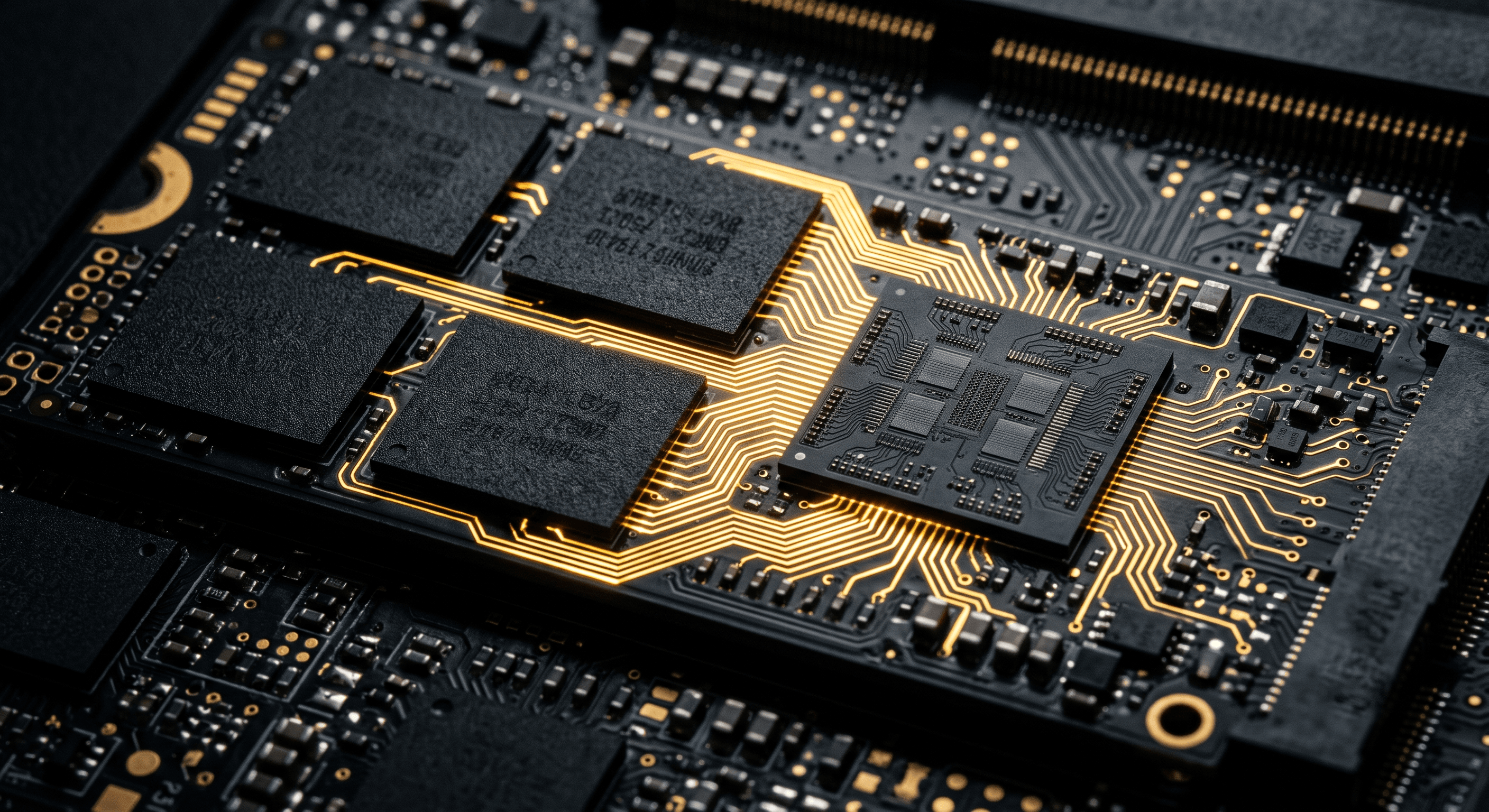

SSD – Solid State Drive is the largest revolution in data storage science in the new laptop world. It is a current storage device, mainly dependent on virtual units, which comes after normal storage devices (HDD) science, that can be used to preserve records for computer systems. The term "Solid State" implies that there are no moving parts like turning magnetic disks or mechanical read/write heads to search statistics like legacy hard drives. Instead of a hard disk, data in an SSD is stored in micro-memory chips (NAND Flash Memory) interconnected with one another.
The general way this works is by the use of a controller chip. The controller serves as the "brain" of the SSD, and stores or retrieves relevant information incredibly fast according to cues from a computer's motherboard. SSD access time is measured in microseconds (millionths of a second), and since it has no mechanical devices involved, it actually takes way less than one millisecond to gain access to information. An SSD can boot the computer desktop (OS – e.g. Windows), launching heavy applications and moving large files ten times faster than a hard disk.
The introduction of SSD technology has brought about a basic change in hardware design in the IT sector. Having no moving mechanical parts, they become silent at some operating point and produce very little electricity. This provides a precious advantage to laptops; because they have lower energy consumption, their battery lasts longer, and the risk of data loss in case of falling or shock is lower. Moreover, the science behind SSDs like M.2 NVMe today has enabled the development of extremely small components that enable building ultra-light and small notebooks with very high-speed computing systems.
How an SSD Works
To understand how SSDs work, you should know their three required components and what they do on their own:
NAND Flash Memory (Data Storage)
This is the region where the actual records are written in an SSD. There are no mechanical parts. Special feature: When electricity is switched off, the records that are stored in these cells do not disappear (non-volatile memory).
Controller (The SSD’s Brain)
The controller is the most important chip that dictates how an SSD works. This serves as a link between the processor of your Computer (CPU) and the NAND Flash memory. It translates all the data in and writes the commands received from the computer. It is responsible for finding the right mobile memory to save data, transmitting data error-free, and controlling the health of the SSD.
DRAM Cache (Fast Buffer Memory)
Essentially, not all SSDs have this part; a great deal of higher-end SSDs actually do. This is quite a fast and temporary memory. This DRAM saves the data that the user gets frequent usage of (for example, browser files or organizational key files) quickly. The SSD will be able to retrieve the file from DRAM when a user reopens it faster than if it had to search for the file in NAND Flash.
Reading and Writing Data on an SSD
An SSD does this by means of a software program utility layer called the "Flash Translation Layer" or FTL. The operation of the controller layer is to map between Logical Addresses, which are visible to an OS running on a computer, and Physical NAND Cells inside the SSD.
The Write Process
SSD is surprisingly amazing with writing data archives, as long as the SSD in question doesn't refresh.
- Programming: To program the data, an electrical charge must be applied so that the relevant cells on the SSD are equipped. In this case, the binary values (0 and 1) are based on utilizing cells with a range of electrons.
- The Write Penalty (Page vs Block): The biggest technical task in SSDs is Page vs Block. Specifically, on an SSD, you normally write data in Pages (small units). However, statistics are removed in Blocks (huge units composed of many Pages). So at the point of writing new information, the old information in that Block must be quickly removed, Block erased, and after this, separate historical archives should be written again. This process is known as Garbage Collection.
The Read Process
It's way easier to read data rather than write.
- Address Mapping: When you open a file, the FTL layer converts the Logical Address provided by the system to a Physical NAND Address to locate physical cells.
- Sensing: The controller takes a voltage measurement of the addressed NAND cells. It detects the corresponding data (0s or 1s) based on the number of electrons in it and transmits this to the processor as an electrical signal. The method takes microseconds because it does not contain a moving read/write head.
Advanced Factors Affecting Performance
Parallelism: Unlike an HDD, a controller in the SSD can talk to multiple chips at once. In Channel Architecture, this is known as an SSD with an 8-Channel controller that reads/writes from eight chips simultaneously, for instance. This massively increases the transfer speed (bandwidth).
Over-Provisioning: In an SSD controller, Over-Provisioning is the aspect in which more space (say 10% or thereabouts) is reserved for internal work (like Garbage Collection and Wear Leveling) than what it allows a user to use. This is required to maintain the lifespan and speed of the SSD.
NAND Flash Types (SLC, MLC, TLC, and QLC)
The speed and durability of an SSD are determined by the method in which data is stored. They are labeled according to how many bits are stored in each cell:
- SLC (Single Level Cell): Each cell contains 1 bit of information only. It is ultra-fast, and the durability is outstanding. However, it is expensive and typically used in servers.
- MLC (Multi-Level Cell): Utilizes two bits per cell.
- TLC (Triple Level Cell): Stores three bits in a cell. This type is the most common today for consumer electronics.
- QLC (Quad Level Cell): Each cell represents four bits. Despite its high storage capability, the durability and write speed are comparatively lower.
Write Amplification (WA) — The Hidden Challenge
SSD Write Amplification is a very important phenomenon that occurs when writing data to an SSD. Because of the way the SSD manages writing at the block level, the controller must write additional background data in addition to the host write request. This causes wear on the NAND memory cells. A good controller will try to minimize this WA value. The closer the WA ratio is to 1, the more effective the SSD.
Bad Block Management
A defective block is a defect of any NAND flash caused by defects in the manufacturing process or later use. The controller detects these bad blocks and 'blacklists' them. At that point, it will cease writing data to that block and use spare healthy blocks instead. This process helps to save data safely.
Data Retention & Decay
Data is stored in an SSD as an electrical charge. If an SSD is kept powered down for a very long time (years), the charge can leak out of the cells and data will be erased. In an extremely hot environment, this data decay is most pronounced. It's one of the biggest points of difference in SSDs compared to HDDs.
Error Correction Code (ECC)
If the voltage readings are changed or translated in NAND cells while reading/writing, data corruption can happen. The SSD controller, for every data write, generates an ECC (Error Correction Code). It reads the data again, checks it against the code, and fixes tiny errors by itself. This guarantees the trustworthiness of the data.
Key Advantages of SSDs
- High Performance: Reading/writing data on SSD takes much less time compared to HDD. The computer boots in a few seconds, software opens within no time, and data is copied at a higher speed.
- No Mechanical Instability (High Durability): Because no rotating disks or needles (read/write heads) are mounted, an SSD cannot easily break under shock or fall. This is especially important for laptops.
- Silent and Low Power Consumption: When it works, an SSD makes zero noise. It also consumes minimal power, which helps in conserving battery runtime for laptops.
- Running Cool: SSDs have little heat generated since there is no mechanical friction, helping control the internal temperature of the computer.
Main Disadvantages of SSDs
- Higher Cost per GB: The cost of an SSD is much higher when it comes to storage size than that of an HDD.
- Difficult Data Recovery: If a hard disk fails, it is comparatively easier to recover data. But when an SSD's NAND chips fail, recovering data becomes extremely hard and costly.
- Limited Write Cycles: SSD has a limited number of times data can be written to its cells (TBW - Terabytes Written). (However, this is not a problem for several years in general use.)
- Sudden Failure: An HDD may give warning signs — it might make clicking noises — whereas an SSD can fail completely and suddenly with no warning. Hence, regular backups are mandatory.
Types of SSD
These types are typically classified by how they interface with the motherboard and the transmission protocol:
SATA SSD (Serial ATA)
It's the oldest and most widely compatible SSD standard. It is designed to use the SATA interface originally built for HDDs. The maximum bandwidth for data transfer is limited by the SATA III protocol (around 560MB/s in real-world use). It uses the AHCI protocol, which was intended for mechanical drives.
NVMe SSD (Non-Volatile Memory Express)
This is the latest and fastest SSD standard. NVMe is optimized specifically for solid-state storage. It communicates using the PCIe (Peripheral Component Interconnect Express) bus on the motherboard, directly with the CPU. NVMe can handle multiple command queues (up to 64k queues, each holding 64k commands), whereas SATA SSDs can only handle one queue of 32 commands.
M.2 and U.2 Form Factors
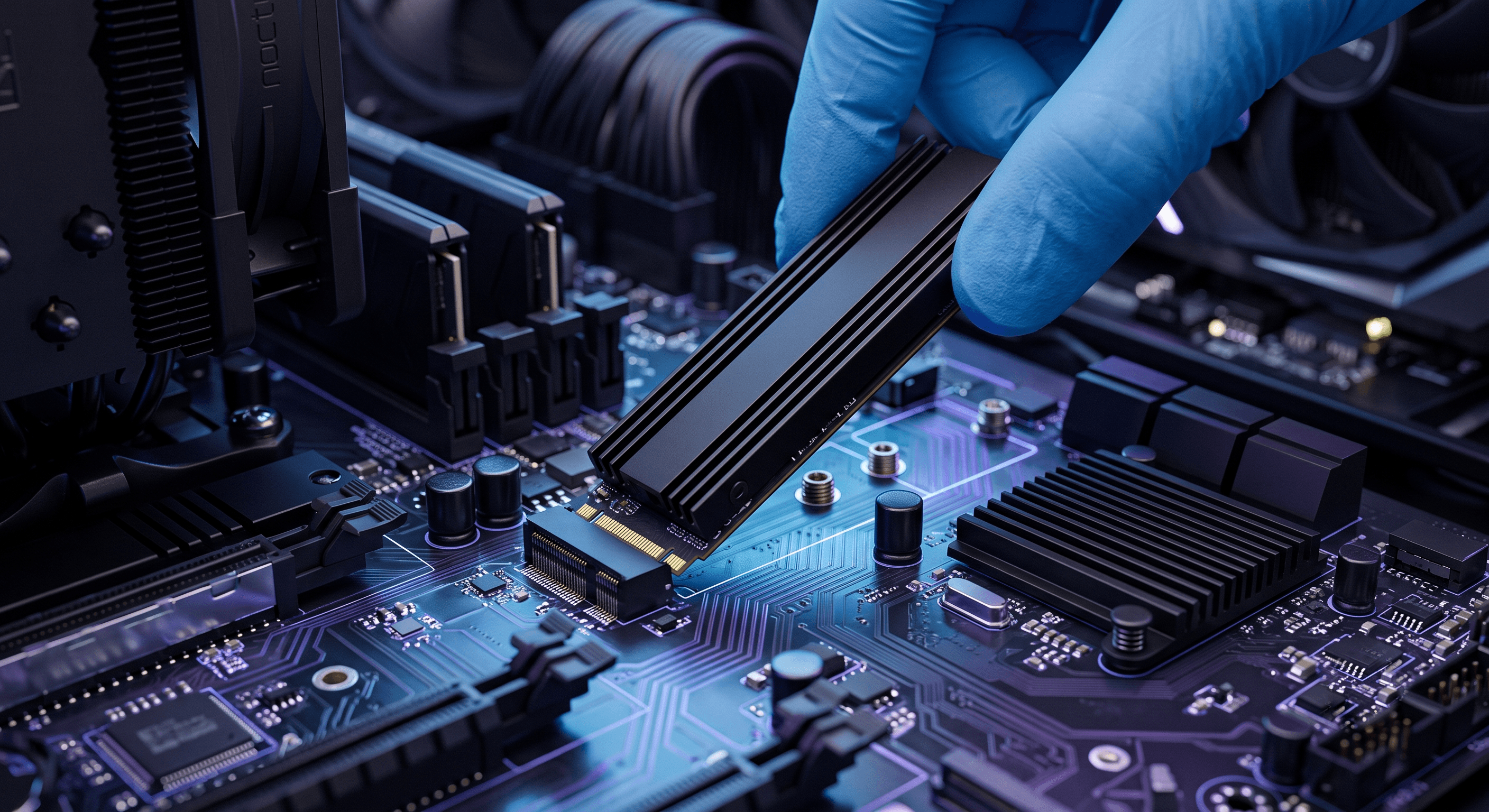
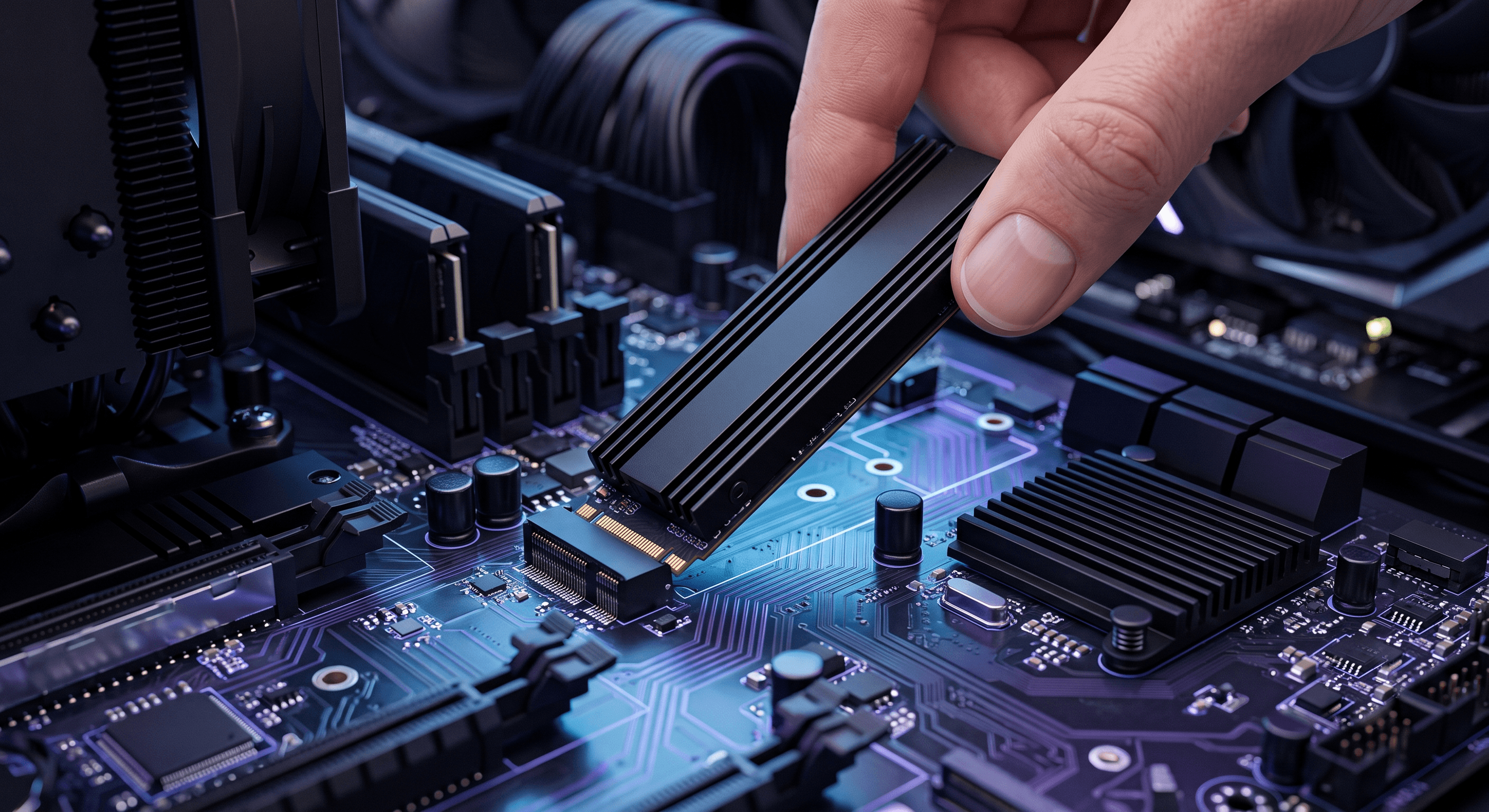
M.2: This is the most popular shape for modern SSDs. It can support both SATA and NVMe protocols. You must check whether an M.2 slot supports SATA or NVMe based on the motherboard keying (B-key, M-key, or B+M key).
U.2: This is primarily used in servers and enterprise-level computers. U.2 drives are larger than M.2 and feature substantial heatsinks to withstand high workloads around the clock.
PCIe Generation (Gen 3, Gen 4, Gen 5)
An NVMe SSD uses PCIe lanes to determine its overall transfer speed. Each new generation doubles the maximum bandwidth of the previous one (Gen 5 is twice as fast as Gen 4, which is twice the speed of Gen 3). The PCIe protocol is backward compatible, meaning a Gen 4 SSD will work in a Gen 3 slot, but its speed will be limited to Gen 3 speeds.